 Global
  English
 中文简体
中文简体 русский
 Español
SGR ' norte Caja de cambios planetar...
Ver detalles
Directorio de noticias
Heavy-duty industrial machinery requires a transmission system capable of delivering high torque reliably while remaining compact, efficient, and easy to integrate into the overall machine design. Among the various types of industrial gear reducers available, the coaxial base-mounted planetary gearbox provides an effective solution for many demanding applications.
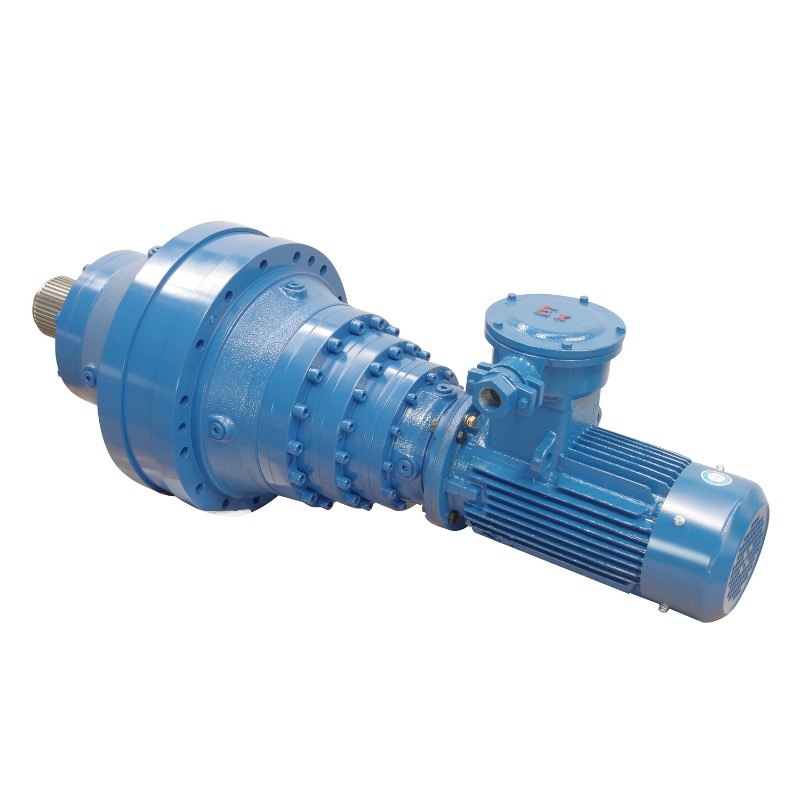
This type of planetary gearbox combines two important structural characteristics: the input and output are arranged coaxially, while the gearbox is securely supported through a base-mounted configuration. Combined with the load-sharing characteristics of planetary gearing, this design provides a compact transmission solution for industrial machinery requiring high torque and stable power transmission.
SGR's N Series includes high-torque coaxial planetary gearbox configurations for demanding industrial applications. The product family uses a modular design and supports different input, output, mounting, and multi-stage configurations. SGR specifies an output torque range of up to T2 ≤ 750,000 N·m and a transmission ratio of i ≥ 3 for the referenced product series.
So, what exactly is a coaxial base-mounted planetary gearbox, what advantages does it offer, and how should engineers select one for heavy-duty equipment?
This article explains the fundamentals.
A coaxial planetary gearbox is a planetary gear reducer in which the input and output are arranged along the same central axis.
Internally, a typical planetary transmission consists of a sun gear, multiple planet gears, a planet carrier, and a ring gear. The planet gears rotate around the sun gear while simultaneously engaging with the ring gear.
One of the major advantages of this arrangement is load sharing.
Instead of transmitting the entire load through a single gear pair, several planet gears can participate in transmitting torque. This helps the planetary system achieve high torque density within a relatively compact structure.
The term base-mounted refers to how the gearbox is installed.
Rather than relying exclusively on an output flange or shaft-mounted arrangement, the gearbox is supported by a mounting base that can be fixed to the machine structure or foundation.
Combining a coaxial transmission layout with a base-mounted structure makes this type of gearbox particularly useful for industrial machines where high torque, stable installation, compact dimensions, and flexible equipment integration are required.
SGR's planetary gearbox portfolio includes coaxial configurations with foot/base, flange, and shaft-related mounting solutions, allowing different arrangements to be selected according to the machine design.
The fundamental working principle is similar to that of other planetary gearboxes.
Power enters the planetary gear system through the input side and is transmitted through the sun gear, planet gears, ring gear, and carrier according to the specific gearbox configuration.
The key feature is that multiple planet gears can share the transmitted load.
This power-splitting principle is particularly valuable in heavy-duty machinery because the required torque does not have to be transmitted through only one gear mesh.
As a result, planetary gearboxes can provide high torque capacity relative to their physical dimensions.
In a coaxial arrangement, the input and output remain on the same axis, producing a streamlined power-transmission path that can simplify integration into many machine layouts.
When a higher reduction ratio is required, additional planetary stages can be connected in series. SGR's referenced coaxial planetary gearbox is based on a highly modular architecture and supports multi-stage combinations for different reduction requirements.
Why are coaxial base-mounted planetary gearboxes suitable for heavy-duty machinery?
There are four major advantages.
The first advantage is the ability to transmit high torque.
Multiple planet gears participate in power transmission and load sharing. This helps distribute the load through the planetary gear system rather than concentrating it on a single gear pair.
For heavy industrial machinery, this is particularly important when the transmission must handle:high operating torque,starting loads,variable loads,repeated load changes,shock loads and long operating cycles.
SGR's N Series coaxial gearbox range includes high-torque configurations, with the referenced Chinese product page specifying output torque of up to T2 ≤ 750,000 N·m. The actual gearbox size and allowable torque must, of course, be selected according to the specific operating conditions and application.
This makes the coaxial planetary architecture relevant to large industrial machinery where high torque must be transmitted within limited installation space.
Another important advantage is the compact architecture.
Because planetary gear systems distribute torque through multiple planet gears arranged around a central sun gear, they can achieve high torque density without requiring an excessively large gearbox.
For equipment designers, this can be particularly valuable when both transmission capacity and installation space are important.
The coaxial arrangement further simplifies the transmission layout because the input and output are positioned along the same axis.
SGR's product documentation also identifies high transmission efficiency, smooth operation, and low noise as characteristics of its coaxial planetary gearbox series.
However, these characteristics do not come from the planetary structure alone. Gear materials, heat treatment, gear accuracy, bearing selection, lubrication, assembly, and manufacturing quality all contribute to the actual operating performance of an industrial gearbox.
One of the strongest characteristics of modern industrial planetary gearboxes is modularity.
A highly modular gearbox platform allows manufacturers to create different transmission solutions using standardized components and different combinations.
For the SGR coaxial planetary gearbox series, multiple planetary stages can be combined to meet different reduction requirements, with the referenced product family covering ratios of i ≥ 3.
Different input options are also available, including:N standard shaft input,MN flange input and customized input configurations.
The output side can be configured with:cylindrical shaft,splined shaft,hollow shaft with locking device,flange connection and customized configurations.
SGR also offers different mounting arrangements, including base mounting, flange mounting, and torque-arm-related configurations.
This flexibility is particularly important for OEM equipment manufacturers.
Instead of redesigning the entire machine around a fixed gearbox configuration, engineers can select a gearbox arrangement that better matches the motor, driven equipment, installation space, and existing mechanical interface.
For large industrial gearboxes, mounting should never be treated as a secondary consideration.
The gearbox must be properly integrated with the machine structure so that loads can be transmitted reliably without introducing unnecessary misalignment or stress.
A base-mounted planetary gearbox provides a practical mounting solution for many fixed industrial drive systems because the gearbox housing can be securely supported on the equipment frame or foundation.
Depending on the application, other configurations such as flange mounting or torque-arm mounting may be more appropriate.
The correct solution depends on factors including:equipment layout,output connection,radial and axial loads,reaction torque,foundation design,shaft alignment and maintenance accessibility.
This is why mounting configuration should be considered during gearbox selection rather than after a gearbox model has already been chosen.
Thanks to their high torque capacity, compact structure, modularity, and flexible configurations, coaxial planetary gearboxes can be used in a broad range of heavy-duty industrial machinery.
Mining machinery frequently operates under heavy loads, vibration, dust, and demanding duty cycles.
Planetary gearboxes can be used in mining transmission systems where high torque and reliable continuous operation are required.
For mining applications, gearbox selection should consider not only rated torque but also peak loads, shock loads, operating time, environmental conditions, and maintenance requirements.
Metallurgical machinery often requires low-speed, high-torque transmission under demanding industrial conditions.
A coaxial base-mounted planetary gearbox can provide a compact drive solution for appropriate heavy-duty metallurgical machinery, particularly where stable installation and continuous power transmission are important.
Large industrial conveyors can require considerable starting and operating torque, especially when transporting heavy bulk materials.
A planetary gearbox can reduce motor speed while increasing output torque, providing the mechanical characteristics required by many conveyor drive systems.
The base-mounted configuration can also simplify integration into fixed conveyor drive stations.
Lifting and winch systems require reliable torque transmission and appropriate reduction ratios.
Planetary gearboxes are commonly considered for high-torque drive systems where compact dimensions are important.
For lifting applications, however, gearbox selection must be based on the complete system requirements, including load conditions, braking, safety requirements, duty cycle, and applicable standards.
Heavy construction equipment requires robust transmission components capable of handling varying loads and demanding working environments.
Depending on the machine architecture, planetary gearboxes can be used for different travel, rotary, or auxiliary drive mechanisms.
Space can be an important design constraint in marine machinery.
The high torque density and configurable structure of a coaxial planetary gearbox can make it suitable for selected marine auxiliary drive applications where compactness and high torque transmission are required.
SGR's referenced N Series product has been applied across industrial sectors including construction machinery, marine auxiliary machinery, mining machinery, and textile and printing/dyeing machinery.
One important question when selecting a planetary gearbox is whether the machine needs a coaxial or right-angle transmission layout.
A coaxial planetary gearbox places the input and output along the same axis.
It is therefore particularly suitable when the motor and driven equipment can be arranged in a straight transmission line.
A right-angle planetary gearbox changes the direction of power transmission, which can be useful when the machine layout does not allow the motor and output equipment to be installed along the same axis.
Neither design is universally better.
The correct choice depends primarily on: available installation space,motor position,driven equipment position,required torque,reduction ratio,input and output interface and maintenance space.
SGR's planetary gearbox range includes both coaxial and right-angle configurations for different shaft-layout requirements.
SGR develops industrial planetary gearbox solutions for demanding transmission applications.
Its N Series uses a modular and serialized design philosophy, allowing different stages, input configurations, output arrangements, and mounting methods to be combined according to application requirements. SGR's current product information lists coaxial and right-angle planetary configurations and multiple mounting solutions.
For gear manufacturing, SGR uses 20CrMnTi alloy steel, with gears carburized and quenched before precision grinding. This manufacturing approach is intended to provide the hardness, wear resistance, and gear accuracy required for demanding industrial transmission applications.
SGR also supports customized planetary gearbox solutions for OEM equipment manufacturers, particularly where standard catalogue configurations cannot fully satisfy requirements for torque, ratio, input/output interfaces, mounting dimensions, or operating conditions.
The N Series is positioned for industrial applications including mining, construction machinery, marine auxiliary machinery, lifting, material handling, and other heavy-duty equipment.
For customers evaluating alternatives to imported industrial planetary gearboxes, SGR also positions this series as a localized alternative for comparable applications. The original product documentation states that the series was developed with replacement of comparable imported reducers in mind. Any replacement project should nevertheless be technically verified according to torque, ratio, dimensions, shaft interfaces, loads, duty cycle, and actual operating conditions rather than assuming interchangeability from model size alone. (Author, SGR, Angie Zhang)
WhatsApp: +86 188 1807 0282
SGR ' norte Caja de cambios planetar...
Ver detalles
Información del producto: el Los reductore...
Ver detalles
Distancia central: 100~710 mm Relación de velocidad: i ≥ 10. Modularización del diseño, se...
Ver detalles
Distancia central: 100~710 mm Relación de velocidad: i ≥ 10. Modularización del diseño, se...
Ver detalles
SGR desarrolla y fabrica reductores de tornillo sin fin especializados para accesorios de maqu...
Ver detalles
SGR desarrolla y fabrica reductores de tornillo sin fin especializados para accesorios de maquina...
Ver detalles
SGR es un fabricante de cajas de engranajes industriales con certificación ISO 9001 y acreditación DNV desde 1996. Suministramos diferentes reductores de engranajes a marcas de todo el mundo.

